Last updated October 30, 2026
Anthropic: pay per token, plus subscriptions
What Anthropic's S-1 says about how it charges, how it counts ARR and where its pricing might go next.
Anthropic is a pay-per-token business. According to its S-1, usage is 80% of revenue. Subscriptions are the other 20%, and their real job is to get people using Claude so their companies start paying for tokens.
Anthropic filed its S-1 on October 26, 2026. Kyle Poyar, who writes Growth Unhinged, pointed out on LinkedIn that pricing gets its own risk factor.
This page is my read of how Anthropic makes money, mapped onto the models on this site. The numbers come from the S-1. The diagram is my interpretation, because nobody outside Anthropic can see the whole picture.
Start with the three questions
The three questions on the overview place a business: who pays, what they pay for and who does the work. Here's how Anthropic answers them.
| Question | Anthropic's answer | Matching model |
|---|---|---|
| Who pays | Companies building on Claude, companies rolling Claude out to employees, and individuals who use it for work | Model and inference APIs and Consumer AI subscription |
| What they pay for | Tokens, priced by the model they pick. Plus Pro and Max plans, and Enterprise seats | Model and inference APIs, with subscriptions mixed in |
| Who does the work | Claude, inside the customer's own products and workflows | Model and inference APIs |
The core: you pay for the intelligence you use
Anthropic calls its main revenue model "pay-for-intelligence." Customers pay for usage, metered in tokens and priced by the model they choose. We would call that the Model and inference APIs business model. Pay-for-intelligence is smart positioning compared to pay-for-tokens or usage, because intelligence implies you're getting valuable results and outcomes, even if you're not paying by the outcome specifically.
According to the S-1, consumption revenue grew from $288 million in 2024 (75% of revenue) to $3.8 billion in 2025 (83%) to $13.1 billion in the first half of 2026 (80%). Subscription revenue grew from $98 million to $789 million to $3.2 billion over the same periods. Anthropic expects consumption to stay "the substantial majority" for the foreseeable future.
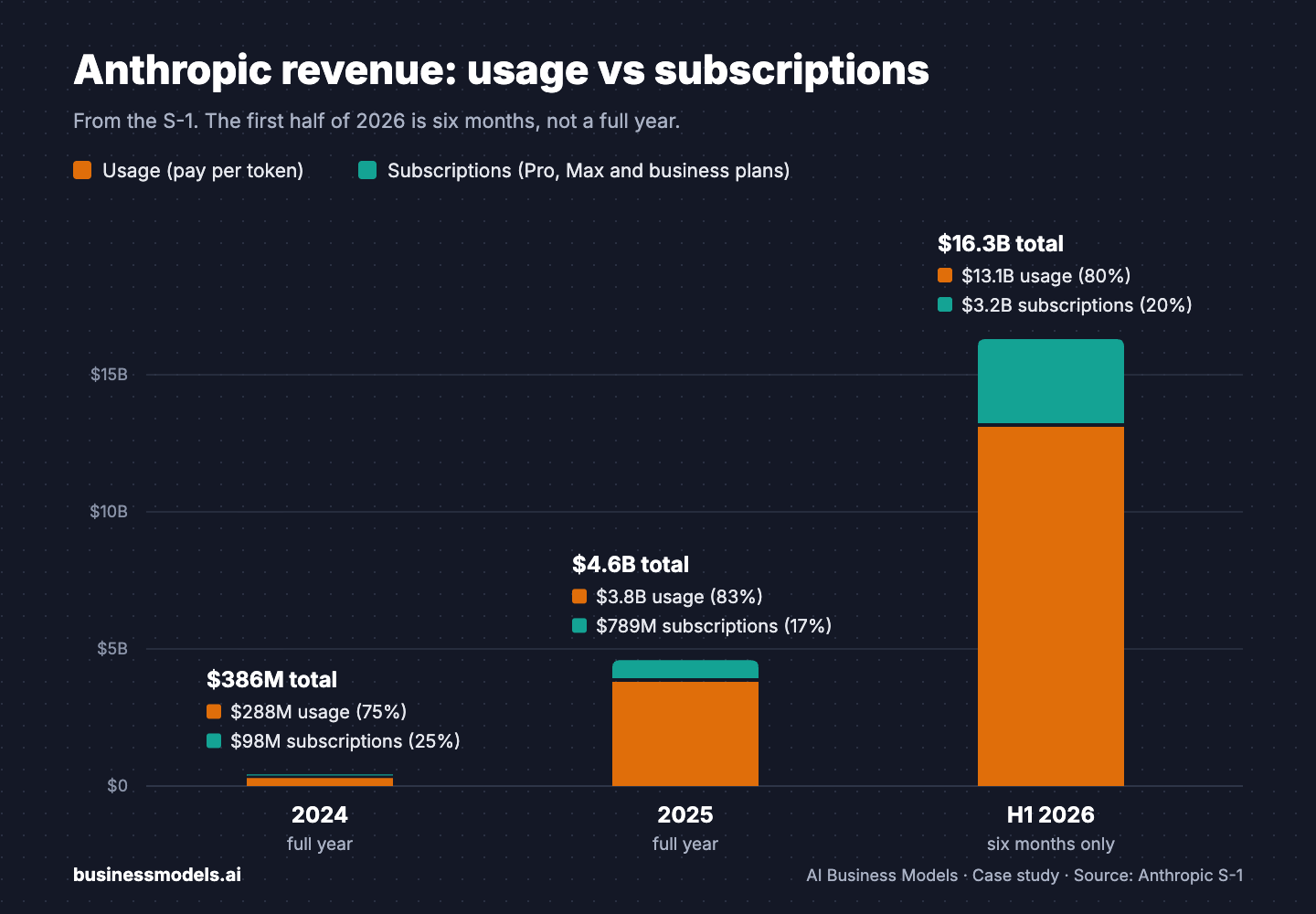
According to the S-1, the subscription share fell from 25% in 2024 to 17% in 2025, then rose to 20% in the first half of 2026. Usage still dominates. The S-1 doesn't break subscriptions down by product, so it doesn't say what drove the rise.
Subscriptions feed the usage business
Pro and Max look like AI subscriptions: a free tier, then paid plans with bigger usage limits. But the S-1 describes them as a way in, not the end game. Individuals use Claude for their own work, then push for it inside their company. It's a classic bottoms-up sales strategy.
The S-1 also describes a bridge: subscribers who hit the limit in their tier can move up a tier or buy more usage directly, which turns subscription revenue into usage revenue. That's the Subscription for usage credits pattern, where a fee buys a set allowance and heavy users pay for more.
Enterprise works the same way. The Register reported in April that Anthropic stopped bundling tokens into Enterprise seats and now bills usage on top at API rates. According to the S-1, Claude Enterprise users who didn't use Claude Code spent less than $75 a month on average, while the top 5% of Claude Enterprise users who used Claude Code spent about 20 times that.
Anthropic's retention metric points the same way. According to the S-1, Net Revenue Retention leaves out Pro and Max subscribers, because fixed-price plans don't reflect the expansion and contraction the metric is meant to capture.
Enterprise deals look like SaaS but bill like an API
According to the S-1, a growing number of enterprise customers sign non-cancelable annual or multi-year contracts with a minimum spend, in return for a committed price list. That sounds like SaaS. But the S-1 says these contracts produce mostly consumption revenue. The customer commits to a floor, then pays for what they use.
Many companies buy Claude through the Amazon, Google or Microsoft cloud marketplace, on the cloud account they already pay for. According to the S-1, that route carried 48% of revenue in the first half of 2026, up from 11% in 2023. The cloud provider sends the bill, collects the money and keeps a fee. Anthropic still sets the price and owns the relationship with the customer.
According to a Reuters estimate reported by Coinpaper, that fee came to about 16 cents of every marketplace dollar in 2025. According to Latent Space, Anthropic books those fees as a sales cost, so they don't show up in its gross margin.
According to the S-1, Anthropic had more than 11,900 customers paying $100,000 or more a year as of September 30, 2026, up from about 20 at the end of 2023.
According to the S-1, Net Revenue Retention was about 900% as of September 30, 2026. That means customers who were paying a year earlier now spend about nine times as much. The S-1 measures it by comparing the latest three months with the same three months a year before, leaving out Pro and Max. It also warns that recent growth partly reflects early customers expanding fast, which may not last.
ARR becomes "Run-Rate Revenue"
The S-1 doesn't report ARR. It reports Run-Rate Revenue: usage fees from the last 28 days times 13, plus this month's subscription fees times 12. (Thirteen 28-day periods make a year.)
A 28-day window makes the number move with the calendar. The S-1 says total customer spend fell about 20% in the two weeks ending January 2, 2026, compared with the two weeks before. Measure Run-Rate Revenue over the holidays and it drops. Measure it the week after a big model launch and it jumps.
According to the S-1, Run-Rate Revenue also counts spending from customers Anthropic later cut off for breaking its usage policy, so part of the number won't come back. And in this version of the filing, the Run-Rate Revenue figure itself is left blank. The S-1 explains how the number is calculated, but not what it is.
That makes it different from ARR at a SaaS company. ARR is usually backed by contracts, where customers have agreed to pay that amount over the next year. Run-Rate Revenue is last month's usage, scaled up to a year. Nobody has promised to keep spending at that rate.
Costs don't move with usage
The Model and inference APIs diagram says cost is GPU cost per token times tokens. Anthropic's S-1 describes something different: most compute is bought under multi-year contracts, 12 to 18 months before it's available. According to the S-1, it's shared across research, model development, serving customers and internal use, and it's mostly fixed in the short term.
So the margin question isn't "what does a token cost to serve?" It's "is revenue growing faster than the compute we already committed to?" According to the S-1, compute and infrastructure fell from 201% of revenue in the first half of 2025 to 55% in the first half of 2026.
Which means in the first half of 2025, Anthropic was spending about $2 on compute for every $1 of revenue it brought in. Now that's not the case: a year later it was about 55 cents. That compute also trains new models, so it's more than the cost of serving today's customers.
According to the S-1, Opus 5.5 cut customers' cost per task by about 40% compared with Opus 5. The S-1 also says quarter-over-quarter revenue growth went from 48% to 132% after Opus 4.5 launched at a lower price, and it credits several factors, lower prices among them. The S-1 says customers have generally expanded their use after launches that lower the cost per task.
On 20VC x SaaStr, Rory O'Driscoll points to the S-1's figure that over 80% of revenue comes from models less than six months old. His read is that sellers of per-token APIs have to keep paying for costly new models to keep earning.
The S-1 names agents as a risk: it says agentic products are "structurally more compute-intensive," and if pricing doesn't keep up, compute efficiency gets worse as agent usage grows.
Pricing is a work in progress
The pricing risk factor says Anthropic has changed its pricing models before and expects to again. It names lower prices, shorter contracts and "outcome or task-based pricing" as possibilities.
This year already shows it. As The Register reported in April, Enterprise moved to seats plus usage. And The Register reported that Anthropic briefly tested making Claude Code available only on Max for about 2% of new signups, then backed off after the backlash. Kyle Poyar's point is that pricing models used to last 18 to 24 months, and now one can be out of date in six.
Outcome or task-based pricing would move Anthropic toward Outcome-priced AI agents or Pay per job. Kyle Poyar notes that OpenAI has started testing outcome-based pricing with some enterprise customers, and that Cognition, the company behind the Devin AI coding agent, now offers a productivity guarantee. He asks whether customers want to pay for intelligence, or for the work it delivers.
What the diagram shows
I drew Anthropic in the same style as the eight model maps. It's built on Model and inference APIs, with the subscription path added.
- Two ways in. Individuals start free in the Claude app, and some who stay free upgrade later. Developers start small on the API. Both end up in the same paying group.
- Three ways to pay, with bridges between them. Subscribers who hit their limit buy extra usage. A subscriber's company signs an enterprise contract. A pay-as-you-go customer commits to a minimum spend.
- Three loops. Each model release brings in new customers, and existing customers who move to it spend more. A share of revenue goes to committed compute, which trains the next model. And paying customers spread use inside their companies, which grows revenue from the same customers. Net Revenue Retention measures that growth.
- Each way of paying has its own exit. Subscribers cancel, usage customers stop or shrink when a project ends, and enterprise contracts end after their term. Subscribers and usage customers can come back. Any customer can also move to another provider.
How Anthropic fits the eight models
| Model | Fit | What the S-1 says |
|---|---|---|
| Model and inference APIs | The core | Tokens, priced by model, are 80% of revenue. Enterprise deals add minimum spend commitments, the same path as the model 1 diagram. |
| Consumer AI subscription | The on-ramp | A free tier, then Pro and Max. The S-1 calls these individual users a "top-of-funnel engine" for the enterprise business. |
| Subscription for usage credits | Partly | Subscriptions buy usage limits that reset over short periods. Hit the limit and you upgrade or buy more usage at token prices. |
| Pay per job | Something they may do in the future | "Task-based pricing" appears in the pricing risk factor. Nothing in the S-1 says Anthropic sells this way today. |
| Outcome-priced AI agents | Something they may do in the future | "Outcome" pricing appears in the same risk factor. Also not something Anthropic sells today. |
| AI-native services | Adjacent, but something Anthropic is investing in | Ode with Anthropic is a new AI services company, set up with private equity firms to bring Claude to mid-sized companies. |
| AI add-on to existing SaaS | No | Anthropic is the AI inside other companies' add-ons, not a SaaS product adding AI. |
| Ad-supported AI | No | The S-1 doesn't mention advertising as a source of revenue. |
The numbers I'd watch
If I ran this scorecard, the key metric would be Net Revenue Retention, because the whole model depends on customers using more each year. The guardrails check that growth doesn't come at the cost of margin or independence.
| Role | Question | What the S-1 shows |
|---|---|---|
| Key metric | Do customers keep spending more? | Net Revenue Retention. About 900% as of September 30, 2026. |
| Guardrail: economics | Is revenue outgrowing committed compute? | Compute and infrastructure as a share of revenue: 201% in the first half of 2025, 55% in the first half of 2026. |
| Guardrail: concentration | How much depends on the cloud providers? | Share of revenue billed through cloud marketplaces: 11% in 2023, 48% in the first half of 2026. |
| Diagnostic | Is growth tied to the newest models? | Share of revenue from models released in the last six months: over 80% in the third quarter of 2026. |
| Diagnostic | Are big accounts still landing? | Customers paying $100,000 or more a year: about 20 at the end of 2023, more than 11,900 by September 30, 2026. |
| Diagnostic | Is the on-ramp still feeding usage? | Subscription share of revenue: 25% in 2024, 17% in 2025, 20% in the first half of 2026. |
What I can't tell from the S-1
The S-1 doesn't split enterprise revenue into seats and tokens. It doesn't say how much usage revenue comes from Anthropic's own apps, like Claude Code, versus developers on the API. And it doesn't give a free-to-paid conversion rate, so the left side of my diagram is the least certain part.
It also doesn't give a margin by product. Because compute is shared and committed in advance, Anthropic may not think about it that way at all.
Go further
- Anthropic's S-1, filed October 26, 2026
- Kyle Poyar's LinkedIn post on pricing in the S-1
- Latent Space on the S-1's margins and cloud marketplace revenue
- 20VC x SaaStr on revenue from new models
- Coinpaper on the fees Anthropic pays the cloud marketplaces
- The Candor case study, another business that blends two models
My interpretation of the S-1, not Anthropic's. On this site, its core is model 1, model and inference APIs.