Last updated October 18, 2026
A living guide to how AI businesses work
Eight AI business models, each with a diagram of how it works, the metrics that matter, the companies using them and the sources behind every claim.
What this is
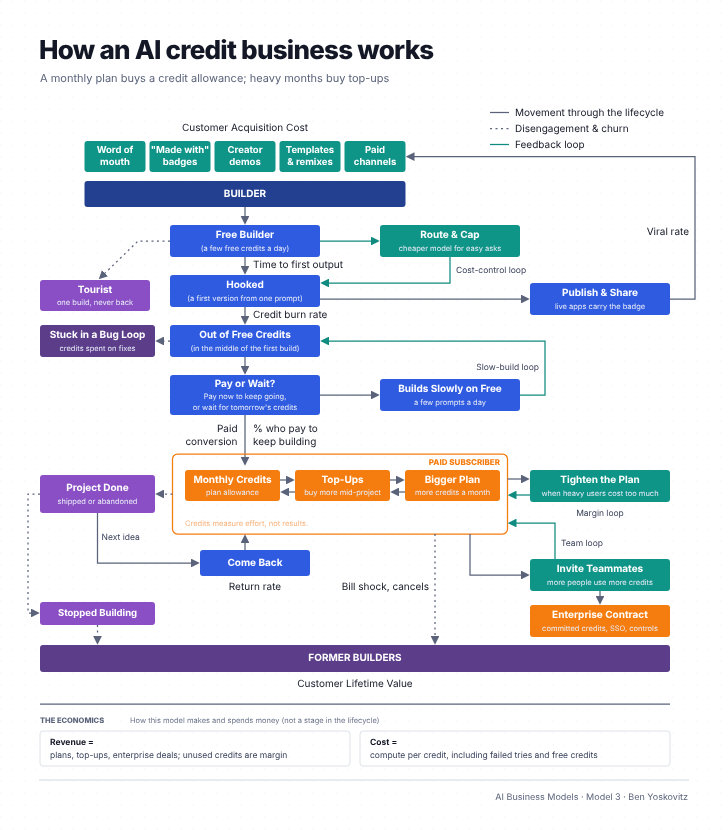
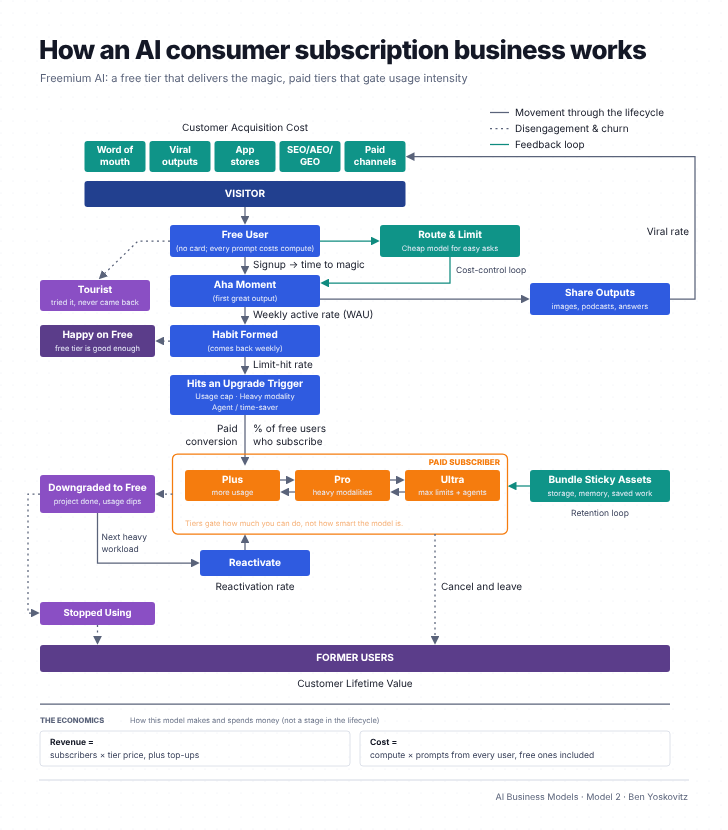
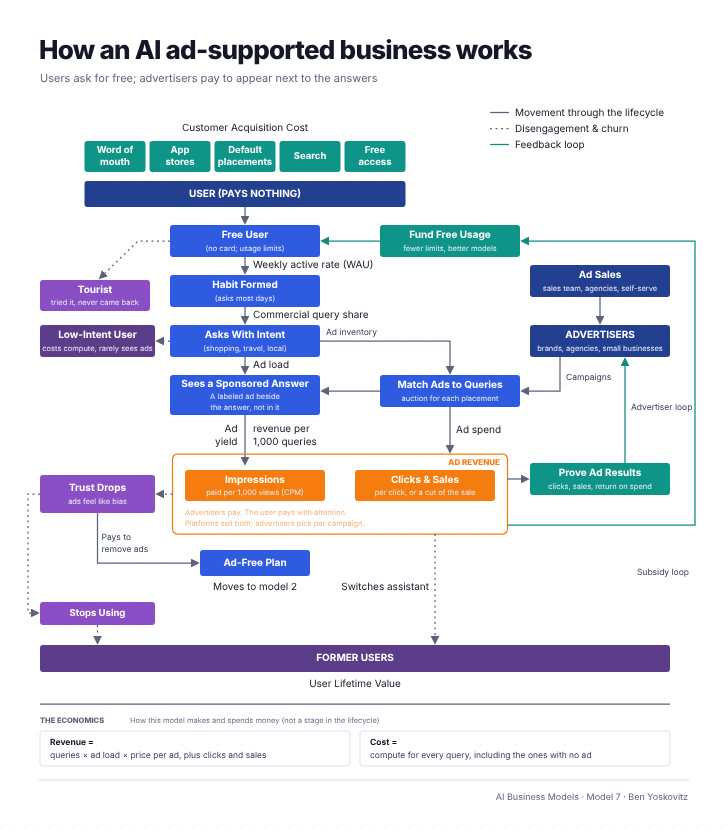
AI Business Models explains how AI companies make money. Each of the eight models gets a systems diagram showing how customers find the product, start using it, pay, expand and leave, along with the loops that drive growth and cost. Each diagram comes with notes on how the model works, example companies, and a table of the metrics to track, with a definition for each one and why it matters.
Real companies rarely fit a single model. ChatGPT runs a consumer subscription, sells enterprise seats, offers an API and now shows ads on its free tier. Separating the models lets you see how each one works on its own, then combine them to describe a real company.
Who it's for
It's for founders deciding how to price and grow an AI product, for product and growth leaders figuring out which numbers to watch, and for investors trying to judge whether a company's economics will hold up as it scales.
Where it comes from
In 2013, Alistair Croll and I wrote Lean Analytics, a book about using data to build better startups faster. One of its core ideas is that the metrics that matter depend on your business model. We described six: e-commerce, software as a service (SaaS), free mobile apps, media sites, user-generated content and two-sided marketplaces. For each one, we laid out how the business works and which metrics tell you whether it's working.
AI breaks some of the assumptions behind those six models. Every user costs compute, so a free user is no longer nearly free, and pricing is moving from seats toward usage, output and outcomes. In AI Changed the Economics. You Still Need a Scorecard, I proposed a seventh model for usage-based AI products. Digging deeper made it clear that one model wasn't enough, so this site covers eight.
Thank you to Alistair Croll, my Lean Analytics co-author, for his help with this project. The business models in Lean Analytics came out of our work together, and this site builds directly on them.
How it's kept up to date
AI pricing changes month to month, so this site is never finished. Each model shows the date it was last reviewed or materially changed, and the overview shows the most recent update. Every factual claim links to a numbered source, and where a point is my own inference rather than reported fact, the notes say so.
Using the diagrams
Every diagram can be downloaded as a PNG, a PDF or an editable PowerPoint file that also opens in Google Slides. You're welcome to use them in your own work. If you share one, please credit Focused Chaos and link back here.
If you spot something wrong or out of date, or know a company that fits a model better, email me at byosko@gmail.com.
Who's behind it
I'm Ben Yoskovitz, a founding partner at Highline Beta, a venture studio and venture capital fund. Before Highline Beta, I was VP Product at VarageSale and at GoInstant, which Salesforce acquired. I co-founded Year One Labs, which incubated five consumer startups, one of which Airbnb acquired.
I write Focused Chaos, a biweekly newsletter about building and investing in startups. I'm also building Candor, a synthetic user research product, which is where a lot of my hands-on thinking about AI pricing comes from.
Follow along. I write about this work as it develops, along with startups, product and venture, in Focused Chaos.
Subscribe to Focused Chaos