Last updated October 18, 2026
How to build an AI business
Pick the model that matches how your customers get value, then track the numbers that tell you it's working.
Why AI needs its own business models
AI changes the economics that most software business models were built on. In classic software, serving one more user costs the vendor almost nothing, so free tiers were cheap and pricing per seat made sense. With AI, every prompt, image and agent run costs compute. A free user can be expensive, a heavy user can be unprofitable, and what the customer values is often a finished piece of work rather than access to a tool.
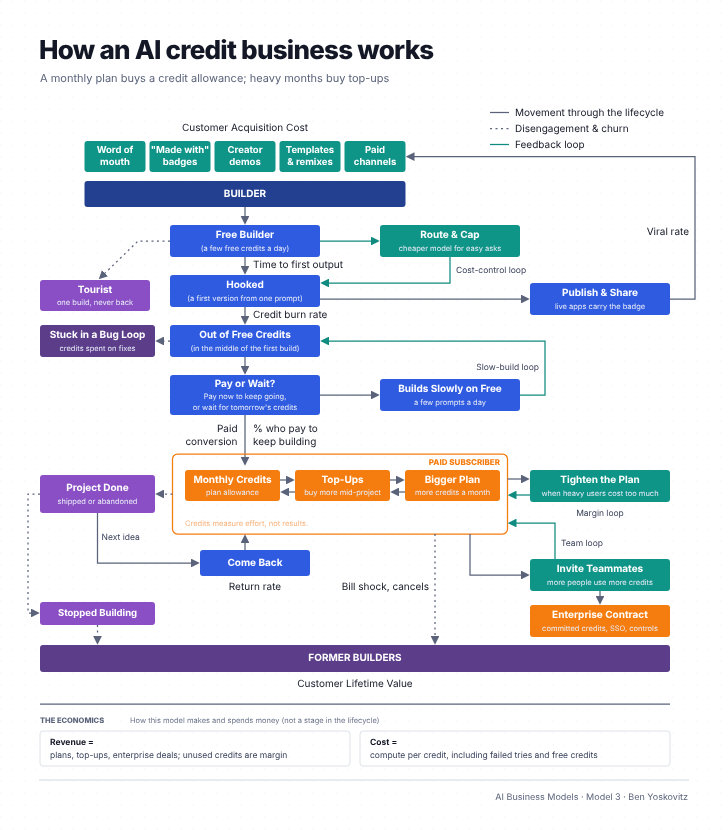
That's why AI pricing is moving away from seats and toward usage, output and outcomes, and why the metrics that matter change with it. A credit business depends on how fast a new user gets a first output. An outcome-priced agent depends on how often it succeeds. Choosing your model tells you which numbers to watch.
How to use this guide
- Find your model. Start with what your customer pays for, below, and pick the closest of the eight.
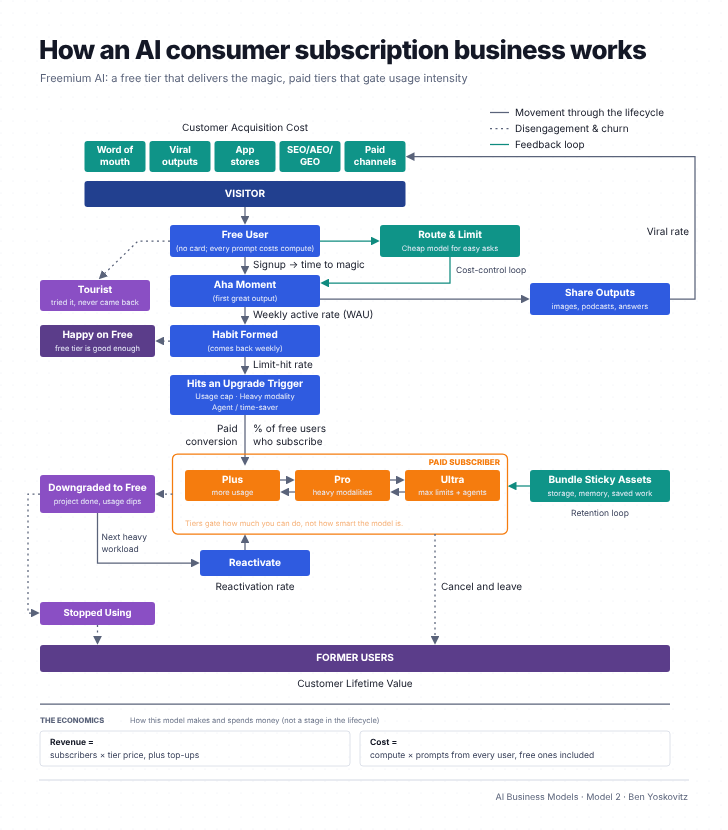
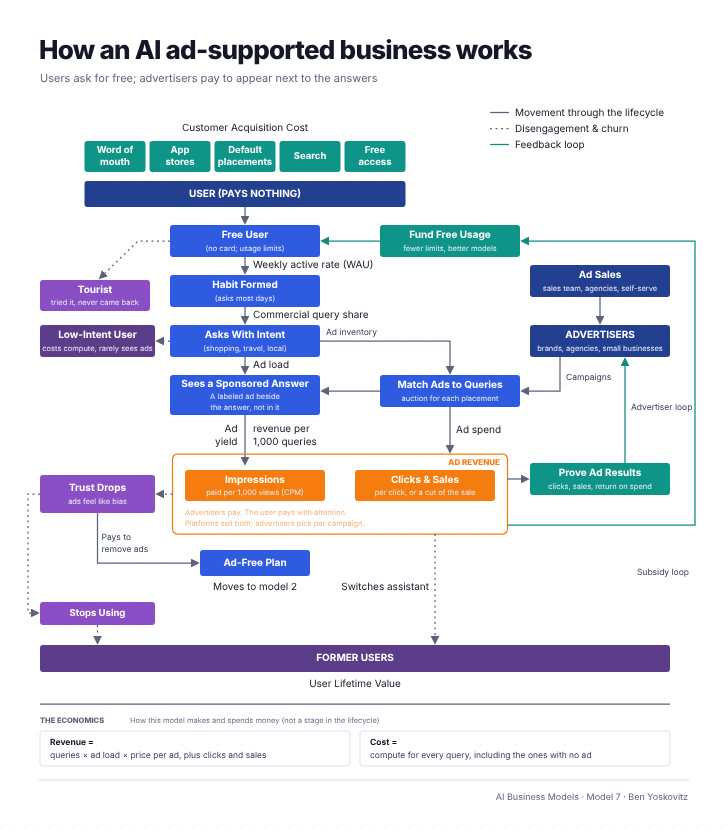
- Read the diagram. Each tab shows how customers arrive, pay, expand and leave, and the loops that drive growth and cost.
- Pick your metrics. Each tab has a table of the metrics to track, what each one means and why it matters.
- Combine models. Most companies run more than one model, so read the tabs for each one you use.
What makes a model distinct
A model counts as its own only if it changes who pays, the unit they pay for, or the loops that drive growth and cost. Credits, budget caps and hybrid fees are pricing levers that show up inside many models, so they're annotations on the diagrams rather than models of their own.
Most real companies are hybrids. ChatGPT is a consumer subscription with ads on its free tier, enterprise seats and an API. Rather than covering every combination, each distinct model gets its own tab, and case studies show how companies combine them.
What the customer pays for
Consumer subscriptions (model 2) gate usage behind tiers. Ads (model 7) and AI-native services (model 8) sit off this line: with ads someone else pays, and with services the customer buys the work itself.