Last updated October 18, 2026
Ad-supported AI
The user pays nothing, so the ads have to cover the compute without costing the user's trust.
In this model, the AI product is free to use and advertisers pay to appear next to the answers. It's the oldest model on the consumer internet, and it's now arriving in AI. OpenAI began testing ads in ChatGPT's Free and $8 Go tiers in early 20261,2, and says its ad business passed $1 billion in annualized revenue by the end of August3. Google's Search revenue grew 19% in the first quarter of 2026 as AI Overviews and AI Mode spread5. The catch is that every answer costs compute, and ads that make users doubt the answers can destroy the product.
Ads have to pay for the compute
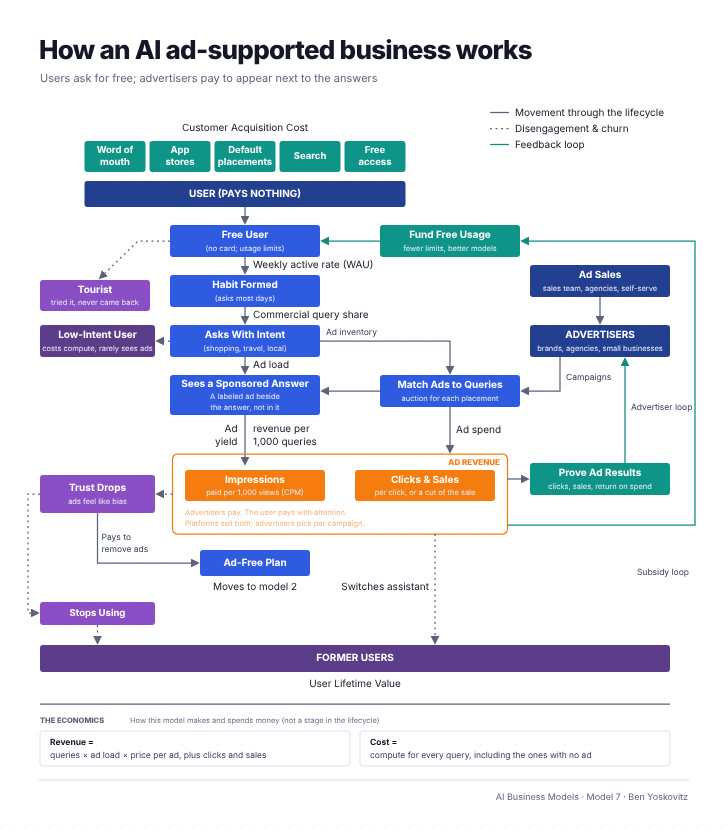
In classic search or social media, serving one more page costs almost nothing. In AI, every answer runs a model. That means the ads shown across a set of queries have to cover the compute for all of them, including the many that never show an ad. Sherwood News, a business news site, reported that ChatGPT ads cost advertisers about $60 per thousand views2. Since May 2026, advertisers can also pay per click11. Ad platforms usually sell both ways at once, and each advertiser chooses by campaign. OpenAI frames ads as a way to fund free use, so that "more people can benefit from our tools with fewer usage limits or without having to pay"1. That's the subsidy loop on the map: ad revenue pays for better free usage, which brings in more users.
Commercial intent is the inventory
Not every question can carry an ad. The valuable ones show buying intent, like shopping, travel and local services. OpenAI won't show ads near sensitive or regulated topics such as health, mental health and politics, and won't show them to users it believes are under 181. Sherwood News gives an example of how it works: a question about running technique might show a sneaker ad, but the answer won't steer toward that brand2. Users who rarely ask commercial questions still cost compute, which is why the map shows them as a drop-off from the money side of the model.
Ad sales is the other half of the business
This is a two-sided market. Users create the inventory, which is every commercial question multiplied by how many ads the product is willing to show. Advertisers buy it, and an auction matches each placement to a campaign. Both sides have to grow together. Inventory nobody buys is compute with no revenue, and advertisers with nowhere to spend go elsewhere. Sizing that inventory and then finding advertisers to fill it is our inference about how it works; OpenAI hasn't described how it forecasts ad capacity.
OpenAI is building the sales side like a media company. In March 2026 it hired Dave Dugan, formerly Meta's vice president of global clients and agencies, to run global ad solutions, according to Skift, a travel industry news site10. By May, it had opened a self-serve Ads Manager to all US businesses, dropped a $50,000 minimum spend and added pay-per-click buying, Quartz, the business news site, reported11. In October, Adweek, the advertising trade publication, reported that OpenAI is hiring to build relationships with agency holding companies, so ChatGPT becomes a regular line in their clients' media plans12. Big brands come through a sales team and their agencies, and smaller advertisers serve themselves.
Trust is the constraint
OpenAI promises that "ads do not influence the answers ChatGPT gives you" and that it keeps conversations private from advertisers1. Others have decided the risk isn't worth it. Perplexity, the AI search engine, stopped taking new advertisers in October 2025 and has since stepped away from ads. One Perplexity executive explained that with ads, "a user would just start doubting everything." The polling firm Ipsos found that 63% of US adults say ads in AI search results make them trust the results less, and Anthropic has committed to keeping Claude ad-free4. That's why the map has a trust drop-off: if users think the answers are for sale, they leave or pay to remove the ads.
Shopping is the other way to cash in on intent
Ads aren't the only way to earn from buying questions. In September 2025, OpenAI launched Instant Checkout, which let ChatGPT users in the US buy from Etsy sellers without leaving the chat, with more than a million Shopify merchants "coming soon." OpenAI said product results were "organic and unsponsored, ranked purely on relevance to the user," and that merchants would pay a fee on completed purchases7. For Shopify merchants, eCommerceNews, a retail technology news site, reported that fee as 4% of each sale, starting in late January 20268. By March 2026, OpenAI was scaling back Instant Checkout to focus on search and product discovery. Shopify's Agentic Storefronts now list merchants' products in ChatGPT by default, but shoppers usually finish buying on the merchant's own site. Modern Retail, a trade publication, noted it's still unclear how many shoppers are comfortable paying inside a chat9. A cut of each sale can be worth more than an ad, but only if people will buy where they ask.
Most ad-supported AI sits beside a subscription
OpenAI says it will always offer a paid tier without ads, and its Plus, Pro, Business and Enterprise plans don't show them1. So ads mostly fund the free and cheapest tiers, with subscriptions (model 2) above them. Smaller AI apps reach advertisers through new ad networks. Koah, one of these networks, places ads inside apps like coding assistants and meal-planning chatbots and takes a 30% cut2, with clients including Luzia, Liner and DeepAI6. ZeroClick, started by Honey co-founder Ryan Hudson, raised $55 million to build one6. Amazon is testing ads inside Rufus, its AI shopping assistant2.
How it flows
- Users arrive through word of mouth, app stores, default placements, search and free access.
- They use the product for free, within usage limits. Some try it once and leave.
- Users who form a habit ask questions most days.
- Some questions show buying intent. Users who rarely ask those still cost compute but rarely see ads.
- Those questions are the ad inventory. An ad sales team, agencies and a self-serve tool bring in advertisers10,11, and an auction matches their campaigns to each placement.
- Commercial questions get a labeled, sponsored placement beside the answer1.
- Advertisers pay for views or for clicks and sales, and merchants may pay a fee on purchases made through the assistant7,8. Results that prove their return bring more ad spend.
- Ad revenue funds free usage, with fewer limits and better models1.
- Users who lose trust in the answers leave, switch assistants or pay for an ad-free plan.
Metrics that matter
| Metric | Definition | Why it matters here |
|---|---|---|
| Weekly active users (WAU) | Users who ask at least one question in a week. | Audience size is the inventory. Advertisers buy reach, so a large habitual audience comes first. |
| Commercial query share | Share of queries with buying intent, such as shopping, travel or local services. | Only some questions can carry an ad. OpenAI keeps ads away from health, mental health and politics1. |
| Ad load | Share of responses that show an ad. | More ads mean more revenue per query, but also more risk to trust in the answers4. |
| Ad yield | Ad revenue per 1,000 queries. | The core unit of this model. It has to cover the compute cost of those same 1,000 queries. |
| Compute cost per 1,000 queries | Model and serving cost for 1,000 queries, with or without an ad. | Every query costs money, including the many that never show an ad. Yield minus this cost is the margin. |
| Fill rate | Share of eligible ad placements that are sold to an advertiser. | Unsold inventory still costs compute. Low fill means the sales side is behind the user side. |
| Active advertisers | Advertisers who spent in the period, split into sales-led and self-serve. | The demand side of the market. More advertisers bidding for each placement raises the price per ad. |
| Return on ad spend | Advertisers' sales or leads divided by what they spent. | Drives the advertiser loop. AI search ads are new, and proof that they work is still thin4. |
| Commerce take rate | Fees earned on purchases made through the assistant, as a share of those sales. | A second way to earn from buying questions. OpenAI charged Shopify merchants 4% before scaling back Instant Checkout8,9. |
| Ad-free upgrade rate | Share of free users who pay to remove ads. | Shows how much ads bother users, and how much subscription revenue sits beside the ads1. |
Examples
Sources
- OpenAI, “Our approach to advertising and expanding access,” January 16, 2026.
- Rani Molla, “The AI chatbot ad rush has begun,” Sherwood News, March 6, 2026.
- Adweek, “ChatGPT surpasses $1 billion in annualized ads revenue,” August 31, 2026. Figure attributed to OpenAI.
- Grace Harmon and Marisa Jones, “Perplexity's retreat from ads marks a split on AI monetization models,” EMARKETER, February 18, 2026.
- Search Engine Journal, report on Alphabet's Q1 2026 results (Search revenue and AI Mode).
- ChatAds, “Top eleven ad networks for AI,” 2026. Written by a competing ad network.
- Rebecca Bellan, “OpenAI takes on Google, Amazon with new agentic shopping system,” TechCrunch, September 29, 2025.
- Joseph Gabriel Lagonsin, “OpenAI to charge 4% fee on Shopify ChatGPT checkout,” eCommerceNews New Zealand, February 3, 2026.
- Allison Smith, “Shopify says purchases are coming inside ChatGPT through Agentic Storefronts as OpenAI retreats on Instant Checkout,” Modern Retail, March 12, 2026. The scale-back was first reported by The Information.
- Adriana Lee, “OpenAI gets serious about ChatGPT ads, hires former Meta exec,” Skift, March 23, 2026.
- Colleen Cabili, “OpenAI is opening its ChatGPT ad platform to all U.S. businesses with self-serve buying,” Quartz, May 6, 2026.
- Trishla Ostwal, “OpenAI wants ChatGPT ads to become a permanent line item in agency media plans,” Adweek, October 9, 2026.