Last updated October 16, 2026
Consumer AI subscription
Converts like freemium, churns faster, and every free user costs money.
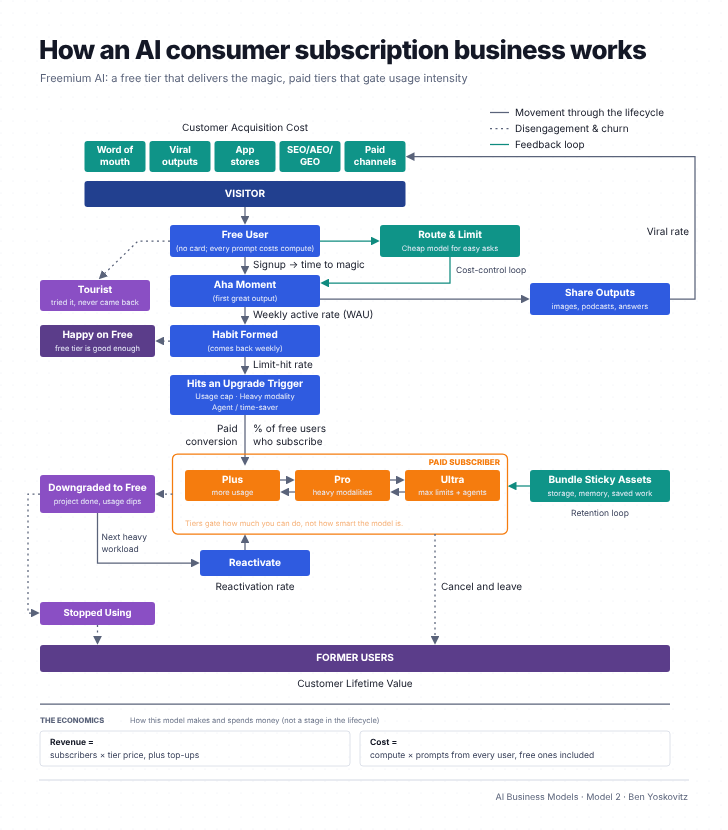
Consumer AI subscriptions look like SaaS freemium, and they convert like it too: ChatGPT turns roughly 5–6% of its weekly users into subscribers3. What's different is everything around that conversion. Free users cost real money to serve, subscribers churn faster, and the heaviest users can cost more than they pay. The model works when two things are true. Paid tiers sell more usage, not a smarter model, so free users get a taste of the best experience and pay when they hit a limit. And something brings people back between bursts of use, so subscribers don't cancel in quiet months.
Every free user runs up a compute bill
In SaaS, an extra free user costs close to nothing. In AI, every prompt from every free user runs on GPUs1. OpenAI has worked to cut the cost of serving even logged-out ChatGPT visitors, reportedly halving its inference cost for them2. The free tier becomes a marketing expense you pay every month, and routing simple prompts to cheaper models is one of the main ways companies keep it affordable1. Fraud makes it worse. Elena Verna, who leads growth at Lovable, points to "bots, stolen accounts, and people abusing free tiers"12, and in AI each of them runs up a real compute bill.
Conversion holds up at 5–6%
OpenAI reported more than 50 million consumer subscribers against more than 900 million weekly ChatGPT users in February 20263, roughly 5–6%. That sits at the top of the range for self-serve freemium SaaS, where Kyle Poyar, who writes the Growth Unhinged newsletter, and Lenny Rachitsky, who writes Lenny's Newsletter, put good at 3–5% and great at 6–8%4. App data points the same way. RevenueCat, which runs subscription billing for more than 115,000 apps, most of them mobile, found that AI subscription apps convert trials to paid at a higher median rate than non-AI apps (8.5% vs 5.6%)5. They also earn 41% more per paying user over the first year5,6.
Keeping subscribers is the hard part
The same RevenueCat data shows AI subscription apps' monthly plans retain 36% worse over 12 months than non-AI apps6, with a higher median refund rate (4.2% vs 3.5%)5. Data from 4,029 software companies collected by ChartMogul, which makes subscription analytics software, shows SaaS products get nearly three times as many plan upgrades as AI-native products7. Part of the reason is that usage comes in bursts. Vikas Kansal, who leads product for Google's AI subscription plans, describes a subscriber who writes ten reports in October and none in November, then cancels1. The upside of that pattern is that people come back: AI-native products win back nearly 10% of churned customers7.
Google gates usage, not intelligence
When Google first put a paywall on Gemini, it used the classic SaaS play: a single $20-a-month Gemini Advanced tier for access to its smartest model. According to Kansal, two things went wrong. The free Gemini app was already capable enough that users asked why they should pay $20 a month, and the power users who did pay consumed so much compute that the unit economics were, in his words, "terrifying"1. Google rebuilt the offer as Plus, Pro and Ultra tiers with rising usage limits and larger context windows, and found that gating usage intensity was a stronger lever than gating model intelligence1. The catch is that people have to understand the limit. Verna points out that ChatGPT describes its tiers' usage as "Limited," "More," "Expanded" and "Maximum," and Anthropic sells its Max plan as 5x or 20x Pro usage. In her words, "Some companies promise 5x more usage without explaining 5x of WHAT"12. Spending is concentrated at the top as well. Olivia Moore, a partner at the venture firm Andreessen Horowitz (a16z), found in US receipt data that the top 10% of US consumers who pay for AI account for about half of observed consumer AI spend, and the top 1% average $903 a month against a $25 median8.
How it flows
- Visitors arrive through word of mouth, app stores, search and shared outputs. No card is needed.
- The free user hits an aha moment (a great first output) and forms a weekly habit, or drifts away as a tourist.
- Routing and limits keep the free tier affordable by sending simple prompts to cheaper models1.
- Habitual users hit an upgrade trigger: a usage cap, a premium modality like video, or an agent feature1.
- Subscribers move between tiers as their usage grows or shrinks.
- Usage comes in bursts, so many subscribers cancel when a project ends and come back when the next heavy workload hits1,7.
- Bundles and sticky assets (storage, memory, saved work) are the retention loop. Google bundles its AI plans with Google One storage1,9.
Metrics that matter
| Metric | Definition | Why it matters here |
|---|---|---|
| Weekly active rate (WAU) | Weekly active users (WAU), meaning free users who used the product at least once in the last 7 days, as a share of all free users. | Habit comes before payment. People who don't come back never hit a limit. |
| Free-to-paid conversion | Share of new free users who start any paid plan within a fixed window (the SaaS benchmark uses six months). | The headline number. Good self-serve freemium SaaS converts 3–5%, great converts 6–8%4. |
| Limit-hit rate | Share of active free users who hit a usage cap or a paid-only feature in a period. | Shows whether the paywall sits in the right place. If almost nobody hits it, the free tier is too generous. |
| Compute cost per free user | Monthly inference cost of serving free users, divided by monthly active free users. | It isn't CAC in the accounting sense, but it works like marketing spend: you pay to serve people in the hope that some convert. Divide total free-tier compute by new subscribers and add it to CAC. If that fully loaded CAC is more than a subscriber's lifetime value, the free tier is too generous. Bots and free-tier abuse add to this cost12. |
| Month-two retention | Share of new subscribers still paying in their second billing month. | The weak spot for AI apps, whose monthly plans retain 36% worse over 12 months than non-AI apps6. |
| Reactivation rate | Share of cancelled or downgraded subscribers who pay again within a set period (for example 3 months). | AI usage comes in bursts, so a lot of lost revenue comes back. AI-native products win back nearly 10% of churned customers7. |
| Gross margin by tier | Subscription revenue for a tier, minus the compute cost of the users on it. | Heavy users on top tiers can cost more to serve than they pay, which is why tiers gate usage intensity1. |
Examples
Sources
- Vikas Kansal (product lead, Google AI subscriptions), “Why SaaS freemium playbooks don’t work in AI,” Lenny’s Newsletter, May 5, 2026. A first-hand account of pricing Gemini’s paid plans.
- The Decoder, reporting The Information: OpenAI cut inference costs for logged-out ChatGPT users by more than half.
- OpenAI, “Scaling AI for everyone,” February 27, 2026: more than 900M weekly active users and more than 50M consumer subscribers.
- Kyle Poyar and Lenny Rachitsky, “What is a good free-to-paid conversion rate?”, Lenny’s Newsletter, August 1, 2023. Survey of 1,000+ products, mostly B2B SaaS, measured as conversion within six months.
- TechCrunch, “AI-powered apps struggle with long-term retention,” March 10, 2026, reporting medians from RevenueCat’s State of Subscription Apps 2026.
- RevenueCat, “The State of Subscription Apps in 10 minutes,” March 19, 2026. Data from 115,000+ apps.
- Kyle Poyar, “The 30-day upsell window,” Growth Unhinged, 2026. ChartMogul data on 10.5M purchases across 4,029 companies, mostly self-serve under $100/month.
- Olivia Moore, “Top 100 Consumer AI Apps, Seventh Edition,” a16z, October 5, 2026. US e-receipt panel data.
- TechRadar, Google AI plan pricing and storage, April 2, 2026.
- Sherwood News, “The AI chatbot ad rush has begun,” March 6, 2026.
- Midjourney documentation, “GPU Speed (Fast, Relax, Turbo).”
- Elena Verna, “What on earth is going on with AI pricing and packaging?”, Elena’s Growth Scoop, October 16, 2026. Verna leads growth at Lovable.