Last updated October 16, 2026
Subscription for usage credits
Customers pay for effort, not results, and the heaviest users can cost more than they pay.
In this model, a monthly plan buys an allowance of credits, and customers buy top-ups or a bigger plan when they run out. It has spread fast among AI-heavy tools, though it's far from universal. Rob Litterst, co-founder of the pricing research firm PricingSaaS, found that 79 of the 500 software companies his firm tracks offered credits by the end of 2025, up from 35 a year earlier1. That's still only about one company in six, but the number more than doubled in a year. The model has produced some of the fastest-growing companies in AI, including Cursor, the AI code editor, and Lovable, the AI app builder. The catch is that credits measure usage, not results. Customers can't tell how much work a month of credits will buy, and vendors can't always tell which customers they're losing money on.
Builders pay in the middle of their first project
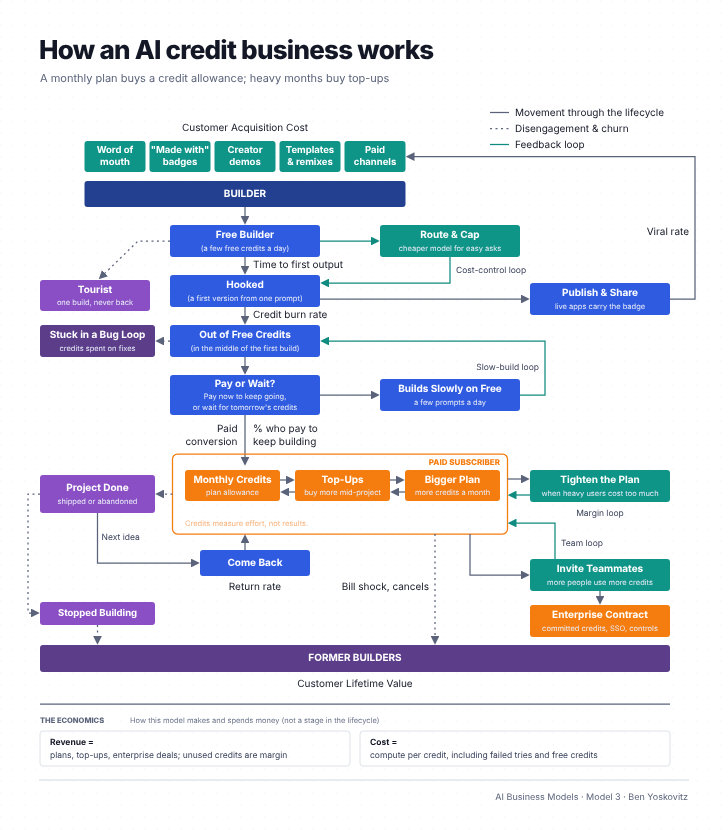
Free credits are deliberately small. Lovable gives free users 5 credits a day, capped at 30 a month9, and one credit buys one message to the AI14. A first session can use up a day's allowance before the app is finished. That makes running out the upgrade trigger, and it usually hits in the middle of the first build, when the builder is most excited. They can pay to keep going, or wait for tomorrow's credits and build slowly. This sequence is our reading of how the pricing works; we haven't found published data on when builders convert.
Credits split the difference between seats and pure usage
Kyle Poyar, who writes Growth Unhinged, a newsletter on how software companies grow and price, explains why credits have spread so fast. Customers get a predictable monthly bill, like a license, and vendors get a usage component that protects margins as usage grows1,2. Lovable's plans show how it works in practice. The Pro plan starts at $25 a month for 100 credits, a dial raises the allowance as high as 10,000 credits, free users get 5 credits a day, and extra credits cost $15 for 509. Lovable told the news site Observer it reached $400 million in annualized revenue by March 202610. Cursor sells a $20 Pro plan that includes $20 of frontier model usage at API prices3, and it passed $4 billion in annualized revenue by June 2026, according to an unnamed source cited by Dealroom, a startup data platform13.
Nobody knows what a credit buys
Elena Verna, who leads growth at Lovable, admits the problem with her own company's plan: "$25/mo gives you 100 Pro credits, but no one knows what that means"16. She argues that credits, tokens and compute units are an "imaginary currency" that puts mental distance between customers and the money they're spending. That makes a plan easy to buy and its cost hard to predict, which feeds bill shock. Her fix is to translate credits into results people understand. Firecrawl, a web scraping API, describes its credits in pages scraped and searches run. Verna also says Lovable would like to charge for outcomes one day, such as hosting or a share of what its users sell, which would move it toward models 4 and 616.
More people use more credits
Expansion in this model doesn't come from selling seats. It comes from more people drawing on the same credits. Lovable's paid plans aren't priced per seat: one workspace's credits are shared across unlimited users9. So when a builder invites a colleague, the price doesn't change, but more people use more credits and the allowance runs out sooner. The workspace then buys top-ups or moves up the credit dial, which on Lovable's Pro plan runs from 100 credits for $25 a month to 10,000 credits for $2,2509. That's the team loop on the map. It applies to other models too, but here it shows up as burn, not seats.
Teams grow into enterprise contracts
The biggest accounts end up on a negotiated contract, and that's where much of the money is. Dealroom reported in March 2026 that about 60% of Cursor's revenue came from corporate customers, though it didn't name its source17. Cursor's Enterprise plan is sold through its sales team, with pooled usage across the company, invoice billing, single sign-on, seat management, spend limits and audit logs18. At Lovable, Enterprise customers buy a committed credit balance for the workspace, and usage beyond it shows up as overage19. Lovable says more than half of Fortune 500 companies use it in some way, and a multiyear deal with Google Cloud makes it easier for large companies to buy it through their existing cloud contract20. Sacra, a research firm that tracks private tech companies, describes a shift at Replit, an AI app-building platform, "from students & prosumers to B2B & large enterprises," helped by listings on the Azure and Google Cloud marketplaces21.
At this level, credits become a committed annual balance with overage, much like an API contract in model 1. The trigger is our inference, not documented: a team's spend gets big enough to need a discount and one bill, or IT and security need controls the self-serve plans don't offer, such as single sign-on, spend limits, and a guarantee that company code isn't used for training18. Some vendors skip the free tier altogether and sell credit plans this way from day one, through a demo and a paid plan, which is closer to traditional B2B software.
Heavy users burn the margin
Poyar has found that about 10% of users can account for 70–80% of token consumption, which makes heavy users very unprofitable without guardrails2. The evidence is everywhere. Newcomer, a tech industry newsletter, reported in August 2025 that Cursor had negative gross margins overall, driven mostly by individual developers on subscription plans, whose compute bills Cursor paid to Anthropic5. Sacra estimates that Replit's gross margin swung between 36% and negative 14% during 2025 because of model costs for its coding agent7. Anthropic itself added weekly limits to its Claude subscriptions after one user consumed tens of thousands of dollars of model usage on a $200 plan6. That's why the map has a margin loop. When heavy users cost more than they pay, the vendor tightens the plan: it caps usage, charges overages, or moves expensive models into pricier tiers.
Re-pricing is where trust breaks
Every one of those fixes landed on customers. In June 2025, Cursor replaced 500 monthly requests with a usage allowance. Some users ran out after a few prompts and others got bills they didn't expect4. Cursor CEO Michael Truell apologized, explaining that "the hardest requests cost an order of magnitude more than simple ones," and refunded the surprise charges3. GitHub Copilot made a similar shift when it started enforcing a monthly cap of 300 premium requests on its Pro plan. Each request to a pricier model counts several times over, and requests beyond the cap cost from $0.04 each11. Clay, the sales data platform, went the other way in March 2026. It split its single credit into data credits and platform actions, cut data prices 50–90%, and expects the change to cost it about 10% of revenue8.
Projects end, so churn comes in waves
Many customers in this model buy for a project, not a job. When the app ships or the idea dies, the subscription lapses. In September 2025, Business Insider reported data from analysts at the investment bank Barclays showing that web traffic had fallen 40% at Lovable from its peak, 64% at v0, Vercel's app builder, since May and 27% at the app builder Bolt since June12. Making unused credits roll over is one way to keep a quiet month from turning into a cancellation. Lovable's monthly credits roll over for two months9, and Clay's data credits roll over up to twice the monthly amount8.
How it flows
- Builders arrive through word of mouth, creator demos, templates and the "made with" badges on apps other people have shipped.
- They start building on a small daily allowance of free credits9. Many try once and never come back.
- A first version appears from one prompt, and they're hooked. Some get stuck spending credits on fixes that don't work.
- They run out of free credits in the middle of that first build. This is the upgrade trigger.
- Hooked builders pay to keep going. Patient ones wait for tomorrow's credits and build slowly on free, until they run out again.
- Paid subscribers move between their monthly allowance, top-ups and bigger plans as their projects get heavier.
- They invite teammates to the workspace. Everyone shares one credit pool9, so more people use more credits and the plan grows.
- Routing easy requests to cheaper models keeps cost down. Cursor's Auto mode is unlimited on Pro because Cursor picks the model3.
- As teams grow, the biggest accounts move to enterprise contracts with a committed credit balance, overage, and the security and admin controls IT requires18,19.
- When heavy users cost more than they pay, the vendor re-prices or adds limits3,6. Done badly, that causes bill shock and cancellations4.
- When a project ends, the subscription often lapses. The next idea can bring the builder back.
Metrics that matter
| Metric | Definition | Why it matters here |
|---|---|---|
| Time to first output | Median time from the first prompt to the first output that looks like what the builder asked for, often in a single prompt (a "one-shot"). | This is the aha moment, and it comes long before the app is done. Free credits run out within a session or two, so the first output has to impress before they do. |
| Mid-build conversion | Share of builders who pay within a day of running out of free credits. | The main upgrade trigger. Builders who are hooked pay to keep going instead of waiting for tomorrow's credits. |
| Credit burn rate | Credits used per active subscriber per week, compared with their monthly allowance. | It drives both revenue (when builders run out and buy more) and cost (every credit used costs compute). |
| Allowance utilization | Share of the credits sold in a period that were actually used. | Unused credits are pure margin, but builders who keep paying for credits they don't use eventually cancel. |
| Top-up rate | Share of subscribers who buy extra credits or upgrade in a month. | Top-ups are this model's expansion revenue, along with bigger plans. |
| Credits per finished task | Average credits used to complete a common task, such as building a simple app or running one analysis. | Turns an abstract allowance into something buyers can plan around. Verna argues credits only make sense when they're translated into results16. |
| Members per workspace | Active people sharing one paid workspace's credits. | Each teammate draws on the same pool, so adding people raises burn and pushes the workspace to a bigger plan. |
| Margin by user decile | Gross margin for each 10% of users, sorted by usage. | About 10% of users can drive 70–80% of token consumption2. An average margin hides the users who lose money. |
| Wasted credit share | Share of credits spent on failed, retried or abandoned generations. | Builders feel they paid for nothing. Clay stopped charging for enrichments that return no data8. |
| Enterprise share of revenue | Revenue from annual or committed contracts as a share of total revenue. | Enterprise customers commit up front and churn less than individuals. At Cursor, corporate customers reportedly bring in about 60% of revenue17. |
| Committed credit utilization | Share of an enterprise customer's committed credits used during the contract. | Under-use puts the renewal at risk. Over-use turns into overage revenue and a bigger commitment next time19. |
| Return rate | Share of lapsed subscribers who pay again within six months. | Projects end, so churn is episodic. Coming back for the next idea is what turns a project into a customer. |
Examples
Sources
- Rob Litterst, “The 2025 state of SaaS pricing changes,” Growth Unhinged, January 7, 2026. Based on the PricingSaaS 500 Index.
- Kyle Poyar, “Why everyone's switching to AI credits,” Growth Unhinged, September 3, 2025.
- Michael Truell, “Clarifying our pricing,” Cursor blog, July 4, 2025.
- TechCrunch, “Cursor apologizes for unclear pricing changes that upset users,” July 7, 2025.
- Tom Dotan, “Cursor's popularity has come at a cost,” Newcomer, August 10, 2025. Based on unnamed sources.
- Anthropic's announcement of weekly Claude rate limits, July 28, 2025, as quoted by Simon Willison.
- Sacra, Replit company profile (revenue, margin and pricing estimates), 2026.
- Varun Anand and Karan Parekh, “Introducing Clay's new pricing,” Clay blog, March 11, 2026.
- Usage Pricing, Lovable pricing blueprint, updated October 5, 2026.
- Let's Data Science, “Lovable posts explosive revenue and user growth,” May 2026, summarizing an Observer interview with Lovable's chief revenue officer, Ryan Meadows. Company-reported figures.
- The Register, “New GitHub Copilot limits push AI users to pricier tiers,” June 20, 2025.
- dev.ua, “Vibe coding tools lose traffic,” September 29, 2025, summarizing Barclays analysis reported by Business Insider.
- Dealroom, “Cursor tops $4B annualized revenue,” June 9, 2026. Based on an unnamed source.
- Dodo Payments, “How Lovable handles billing: a complete breakdown,” 2026.
- Moselle, “Pricing,” accessed October 16, 2026.
- Elena Verna, “What on earth is going on with AI pricing and packaging?”, Elena’s Growth Scoop, October 16, 2026. Verna leads growth at Lovable.
- Dealroom, “Cursor doubles revenue to $2B amid slowdown speculation,” March 2026. The 60% corporate share is not attributed to a named source.
- Cursor, “Pricing” (Teams and Enterprise plans), accessed October 16, 2026.
- Lovable documentation, “Plans and credits,” accessed October 16, 2026.
- Julie Bort, “Lovable signs multiyear deal with Google Cloud to up usage 5x, source says,” TechCrunch, June 3, 2026. The Fortune 500 figure is Lovable's own claim.
- Sacra, “Replit passes $500M/year,” 2026.